Open Banking has reached a pivotal moment.
The conversation has moved beyond what it is and why it matters. Today, the focus is shifting towards something far more fundamental – and often overlooked:
Can the infrastructure truly support it at scale?
Because while Open Banking promises faster payments, lower costs, and greater control, none of that matters if the system cannot deliver consistently, reliably, and in real time.
This is where the real battle for adoption is being fought.
Not in user interfaces. Not in regulation. But deep within the architecture that powers every transaction.
The Hidden Layer Behind Open Banking Success
When a consumer selects “Pay by Bank” at checkout, the experience appears simple.
A few taps. A bank authentication. A confirmed payment.
But beneath that simplicity lies a highly complex ecosystem of APIs, bank connections, third-party providers, and payment rails – all of which must work together seamlessly in milliseconds.
This is the hidden layer of Open Banking. And it is here that success or failure is determined.
Unlike traditional card schemes, which have spent decades refining their infrastructure, Open Banking operates across a distributed network. Multiple banks. Multiple APIs. Multiple points of potential failure.
The expectation, however, remains the same. It must work. Every time. Instantly.
The Challenge of Always-On, High-Volume Payments
As adoption grows, so too does the pressure on infrastructure.
What works at low or moderate transaction volumes does not always translate to high-volume, peak-time environments.
This is one of the core challenges facing Open Banking today.
High-volume payment scenarios – such as e-commerce checkouts, ticketing platforms, or subscription billing – demand real-time responsiveness, near-zero downtime, and consistent performance across all banking connections.
And this is where the gap begins to emerge.
As highlighted in our Open Banking Challenge Series, performance disparities between Open Banking and card schemes remain a concern, particularly for large merchants handling significant transaction volumes.
The issue is not capability. It is faith in the consistency under pressure.
The Cost of Downtime and Latency
For merchants, payments are not just a function. They are the point of revenue.
Any friction – whether it is a failed transaction, a delay, or a timeout – directly impacts conversion rates and customer trust.
In a high-volume environment, even minor latency can have major consequences.
A slow authentication flow increases abandonment. A failed payment erodes confidence. Downtime during peak trading hours leads to immediate revenue loss.
And unlike cards, where the infrastructure is largely centralised and predictable, Open Banking introduces variability.
Different banks perform differently. Different APIs respond at different speeds.
Without a robust architectural layer to manage this complexity, the merchant experience becomes inconsistent. And inconsistency is the enemy of adoption.
Infrastructure Maturity: The Missing Link in Adoption
The industry has spent years focusing on the benefits of Open Banking – cost savings, security, consumer control.
All valid. All important. But increasingly, we are seeing that infrastructure maturity is the true enabler of scale.
Merchants will not fully commit to a payment method unless they trust it to perform under all conditions.
This is the same lesson learned during the rollout of card payments.
Standards, regulation, and technology were essential – but it was reliability and guaranteed performance that ultimately drove adoption .
Open Banking is now at that same inflection point. The technology is ready. The question is whether the infrastructure can keep up.
Building for Resilience: obconnect’s Approach
At obconnect, we recognise that Open Banking success is not just about enabling payments.
It is about ensuring those payments work – every time, at any scale.
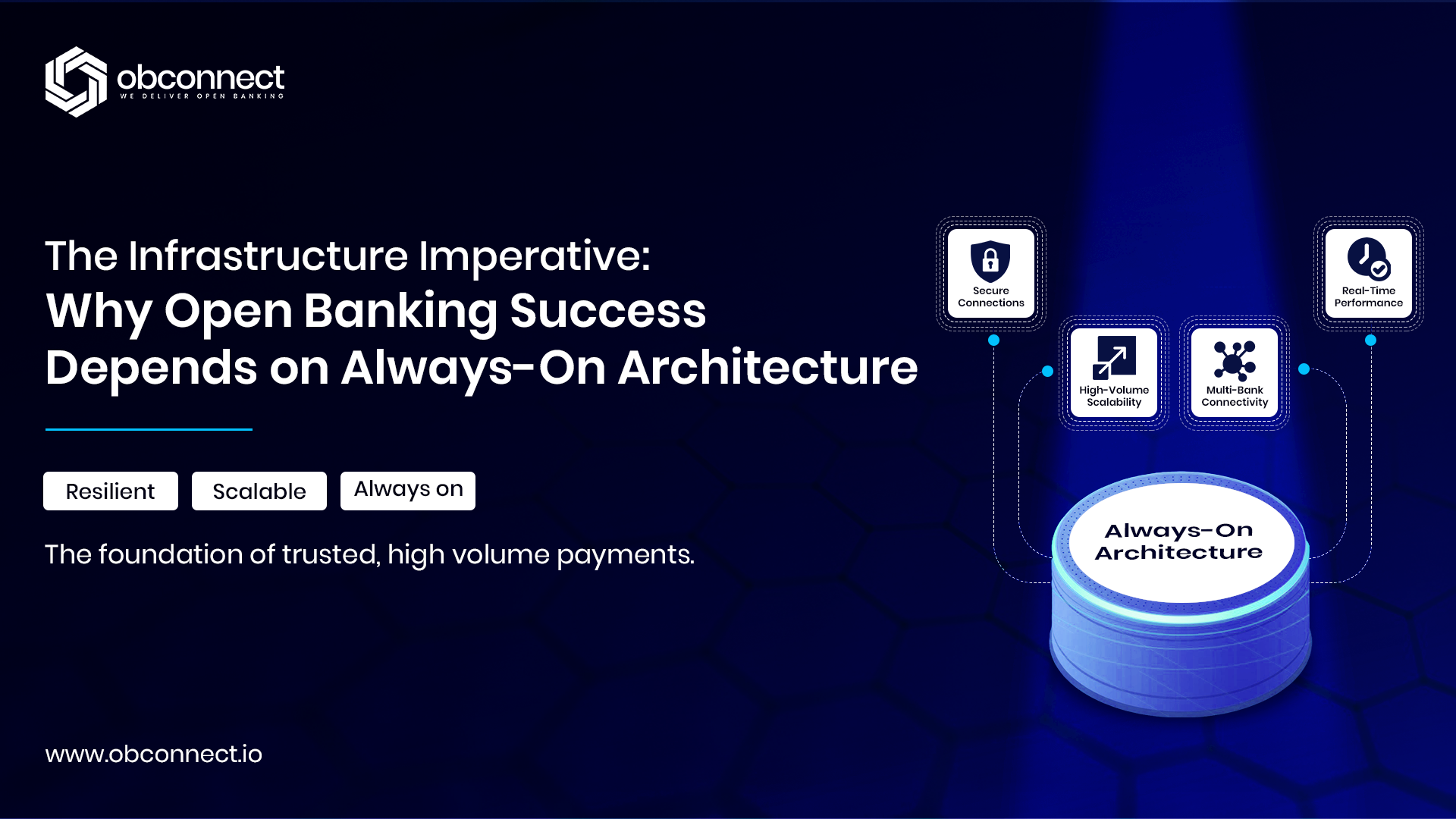
That is why our approach is built around resilient, always-on architecture designed specifically for high-volume environments.
Key principles that guide our infrastructure:
- Redundancy by design ensures that failure points across banks, APIs, and connections are anticipated and mitigated.
- Performance optimisation reduces latency and improves response times across the payment journey.
- Intelligent routing manages variability between bank connections to maintain consistent performance.
- Scalability at core allows merchants to grow without compromising reliability.
- Real-time monitoring and response ensures continuous visibility and rapid issue resolution.
This is not just about technology. It is about confidence.
The Future of Open Banking Depends on What Happens Next
Open Banking has already proven its value. It is secure. It is efficient. It is cost-effective.
But for it to become truly mainstream, it must also be unfailingly reliable. Because at scale, reliability is not a feature. It is the expectation.
As the UK moves towards greater adoption of Pay by Bank and account-to-account payments, the spotlight will increasingly fall on infrastructure.
The winners in this space will not just be those who enable payments.
They will be those who ensure those payments never fail.
Final Thoughts: Infrastructure Is Not the Background – It Is the Product
In many ways, infrastructure has always been seen as the background layer of payments.
Invisible. Technical. Secondary. That perception is changing.
In Open Banking, infrastructure is the experience. It defines speed. It determines reliability. It shapes trust.
And ultimately, it decides whether adoption accelerates – or stalls.
Ready to Strengthen Your Open Banking Infrastructure?
At obconnect, we help businesses build and scale Open Banking payment solutions on infrastructure designed for real-world performance.
If you are looking to deliver fast, reliable, and scalable Pay by Bank experiences, speak to our team today.