You know the pair. The shoes at the back of the cupboard you reach for without thinking – moulded to your feet, been everywhere with you. You’ve noticed they’re tired: the sole’s worn thin, the support’s gone. But the thought of breaking in something new is enough to make you reach for the old ones one more time.
Most Confirmation of Payee contracts are exactly that pair of shoes: familiar, predictable, and quietly past their best. And just as worn shoes stop supporting you long before you admit it, an ageing CoP contract can stop serving your business while still feeling perfectly fine to renew – all while costing you more than it should. This is a case for finally trying the new pair on.
Comfort versus change
The pull of the old shoes is comfort – you know exactly how they feel. Service contracts work on the same instinct: the integration is done, the invoices are predictable, nobody has to learn anything new. That predictability feels like security.
But comfort and security aren’t the same thing – and “predictable” invoices aren’t the same as good value. With a worn pair of shoes, comfort and protection have quietly come apart. With an ageing CoP contract, so have cost and value: you’re still paying, often more each year, for a service that’s doing less than a modern one would.
Worn-in, and trusted anyway
Even when the shoes are clearly past it, you still think of them as perfectly good. They’ve earned your trust, so you keep extending it long after they’ve stopped earning it.
Old CoP contracts get the same benefit of the doubt. They were fit for purpose when name-checking was new and the bar was lower – and, crucially, when many were priced on a per-transaction or volume basis that looked cheap at launch and grows more expensive every year as your check volumes climb. The market has moved on: Verification of Payee has arrived, APP reimbursement has made responder accuracy a shared financial liability, and pricing models that don’t punish growth now exist. A familiar contract can quietly be both less protective and more costly than the alternative.
The cost case – what you actually pay
Switching provider is often framed as a cost. Done right, it’s the opposite. Here’s where the money actually moves with obconnect:
- No transaction or volume-based fees. obconnect doesn’t charge per check or by volume, so a busy month doesn’t mean a bigger bill – and growth stops being something you’re penalised for. If your current contract meters usage, this is where the biggest saving usually sits.
- One supplier, not many. CoP and Verification of Payee run on a single connection, so you’re not licensing, integrating and maintaining separate tools for each capability. Consolidating suppliers cuts both the direct spend and the hidden cost of managing multiple vendors.
- Lower fraud and error losses. Stronger, more accurate name-checking means fewer misdirected and authorised push payment losses – and under the reimbursement regime, that’s real money kept off your P&L rather than paid out.
- Less manual work. Fewer failed and returned payments means less exception handling and reconciliation – the operational cost that never shows up on the invoice but quietly eats your team’s time.
- Lower compliance overhead. obconnect stores no customer data, reducing the security and compliance burden that comes with holding it.
Predictable, flat, all-in-one cost against a bill that grows with every check – that difference compounds over the life of a contract.
The moment you need better support
You can ignore tired shoes right up until your feet start to complain. The payments landscape is at that point now: fraud is more sophisticated, customers expect payments to be right first time, and regulators expect firms to actively prevent misdirected and APP fraud rather than clean up afterwards.
That’s the support a modern CoP service is built to give – better accuracy on the name check, stronger protection against fraud and error, and the reliability to do it at volume without falling over. obconnect’s Confirmation of Payee is designed for exactly this: high-accuracy verification as both requester and responder, on infrastructure built to stay up when it matters most – which is also what keeps those fraud and failed-payment costs down.
The bit everyone dreads – breaking them in
Nobody wants the blisters. New shoes mean a stiff, awkward fortnight; switching providers carries the same dread – the assumption that migration means months of disruption, integration work and cost.
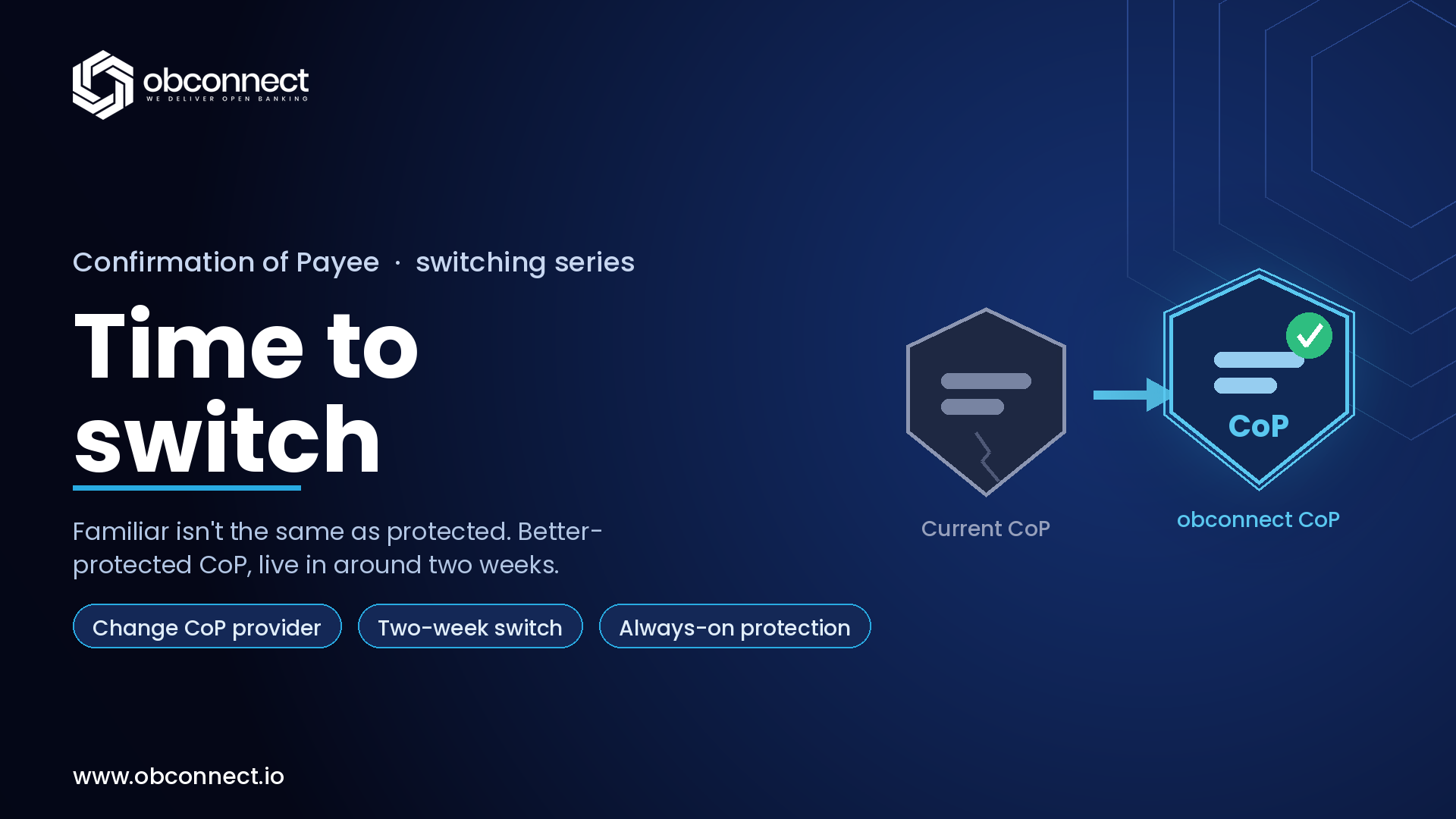
With obconnect, that break-in is short by design. Because obconnect operates as a Pay.UK Aggregator with managed onboarding, joining is a connection to a proven platform rather than a rebuild – and typical implementations complete in around two weeks. That keeps the switching cost itself low: less internal engineering time, less project overhead, and a faster path to the savings on the other side. A fortnight of change against years on a contract that costs more and protects less is not a hard trade.
Better protection, a better stride – and a lower bill
The reward for pushing through the break-in is the thing you forgot you were missing. A good new pair doesn’t just stop the aching – it improves how you move.
That’s the shift firms describe after moving to obconnect. The service is built for near-continuous uptime, so name checks don’t stall mid-payment. It’s all-in-one, so you’re not maintaining a different supplier for every capability. And it charges no transaction or volume-based fees, so growing volumes don’t mean a growing bill. Better protection, less operational drag, and a cost base that doesn’t creep – working quietly in the background, which is exactly where good infrastructure belongs.
The long-term payoff
Once the new shoes are broken in, you don’t think about them again – you just notice walking got easier. The value isn’t in the purchase; it’s in every mile afterwards.
Switching CoP provider works the same way. The change is a short, contained project. What follows is a smoother, safer, more reliable service that protects your customers, reduces your fraud and error exposure, holds your costs flat as you grow, and stops being something you have to think about. The comfortable old contract felt like the safe choice. The genuinely safe – and more economical – choice is the one that supports you properly for the years ahead.
Your current CoP contract has served you well. That doesn’t mean it still fits, and it may be costing you more than you realise. If it’s looking worn, it’s time to try a better pair on.
Talk to obconnect about switching your CoP service
Often, yes. obconnect charges no transaction or volume-based fees, consolidates CoP and VoP onto one connection, and reduces fraud, failed-payment and reconciliation costs – so total cost typically falls, especially as volumes grow.
No. Pricing isn’t metered by transaction or volume, so your costs stay predictable as check volumes rise.
Typically around two weeks, because obconnect is a Pay.UK Aggregator with managed onboarding – a connection rather than a rebuild, which keeps switching costs low.
High-accuracy checking as requester and responder, near-continuous uptime, and Verification of Payee on the same connection.
“Fine” often means familiar – and familiar can mean a volume-priced contract that’s quietly getting more expensive while protecting you less than a modern service would.