Confirmation of Payee changed UK payments for the better. By checking that a payee’s name matches the account before money moves, CoP has stopped countless misdirected and fraudulent payments. But fraud has adapted – and the landscape keeps shifting. So a fair question is starting to surface across the industry: what comes next, and could it amount to a “CoP 2.0”?
There’s a candidate already taking shape. Pay.UK is developing a standardised way for banks to share richer fraud-relevant data before a payment leaves the account – known as the Enhanced Fraud Data (EFD) standard and its delivery model, Enhanced Data Exchange (EDEx). Might this be the natural successor to CoP? It’s worth examining what it is, why it could matter now, and how banks and PSPs might prepare.
What CoP does – and where it may be reaching its limits
CoP answers one question: does the name match the account? That’s powerful at the point of payment, and it remains a baseline expectation across UK banking. But there may be limits to how far a single check can go. A name check can’t see whether an account is a freshly recruited mule, whether the payment fits the customer’s behaviour, or whether the wider pattern around a transaction looks like a scam in progress. Fraudsters have arguably learned to work around a single yes/no signal.
The scale of the residual problem is telling. APP scam losses still reached £576 million in 2025 (UK Finance), and under the mandatory reimbursement regime UK banks refunded £354 million to victims – with liability split 50/50 between the sending and receiving institution. CoP narrowed the gap; it didn’t close it. Closing it may need more than a name.
Could “CoP 2.0” be Enhanced Data Exchange (EDEx)?
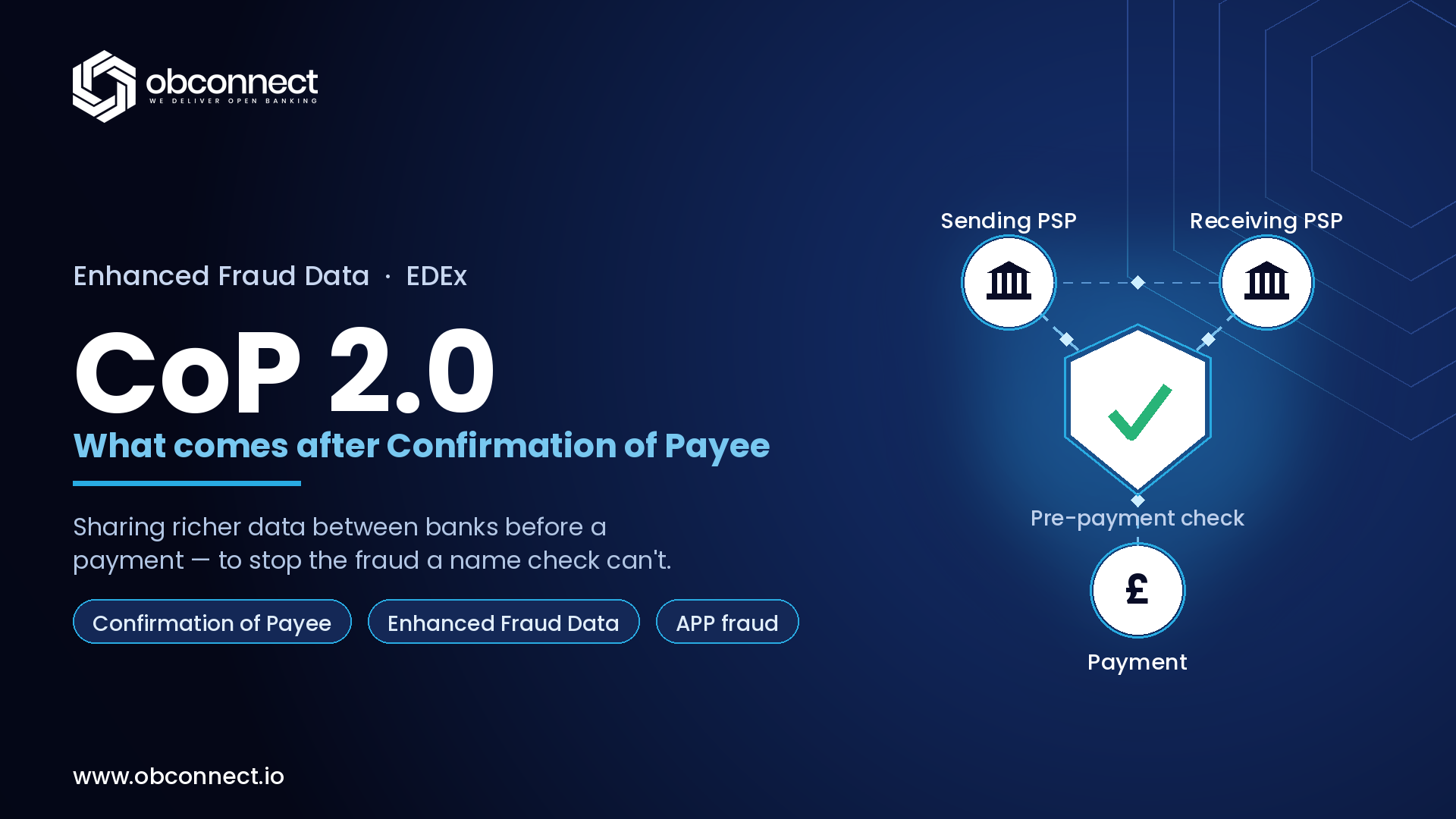
Enhanced Data Exchange is, in Pay.UK’s words, “the next iteration” of its work to significantly reduce fraud by using additional data to improve detection and prevention. In practice, EDEx would be the exchange of specified data points between payment service providers before a payment transaction is made – putting more relevant information into the payment journey at the moment it matters.
The mechanism Pay.UK has been designing with industry is a peer-to-peer API that builds on existing Pay.UK infrastructure, intended to let PSPs exchange certain agreed data points before a credit transfer occurs. That extra context could help a receiving or sending PSP tell genuine transactions from likely-fraudulent ones – potentially doing two things at once: reducing the chance of a legitimate payment being stopped incorrectly, and increasing the number of fraudulent payments caught and prevented. Fewer false positives, more fraud stopped.
It’s why some – obconnect included – have started to wonder whether EDEx is, in effect, CoP 2.0. If CoP verified identity at the door, EDEx could be the intelligence that decides whether to open it. Whether the label sticks matters less than the direction it points to.
The story so far – from EFD to EDEx
Whatever it ends up being called, this isn’t a concept on a whiteboard. It has a documented track record:
- 2021 – Pay.UK and UK Finance established the Enhanced Fraud Data Standards Group (EFDSG) to develop a standard for sharing enhanced data between financial institutions.
- February 2022 – Phase 1 completed: industry specialists identified the key data points that help economic crime teams spot suspect payments sooner, and built a logical data model to organise that data consistently across organisations.
- 2023 – Phase 2 completed and the first iteration of technical collateral published for industry review, defining the structure and usage of specific data fields. The EFD standard was tested through two proofs-of-concept led by UK Finance, which demonstrated significant potential to reduce fraud.
- 2025 – 26 – building on EFD, Pay.UK defined EDEx as the delivery approach: the peer-to-peer, pre-payment data-exchange API described above.
The throughline is standardisation. If every party agrees how data is structured and defined, sender and receiver could hold it in exactly the same format – removing ambiguity, speeding up decisions, and reducing the risk that fraud slips through the gaps between institutions.
Why it could matter now
Two forces may make this pressing for banks and PSPs. First, the reimbursement regime has put a price on every scam that succeeds, shared 50/50 across the payment – so catching fraud earlier is arguably now a direct balance-sheet benefit, not just a customer-protection goal. Second, customer experience is increasingly a fraud metric: every genuine payment wrongly blocked is friction, complaints and lost trust. EDEx looks like one of the few interventions that could improve both sides of that equation at once.
CoP remains essential – it’s the foundation. But if this is the direction of travel, institutions that treat name-checking as the finish line could be the ones still absorbing avoidable losses while peers move to richer, pre-payment data sharing.
What it could change for banks and PSPs
- Fewer false positives. Richer shared data could mean genuine payments are less likely to be stopped, reducing friction and complaints.
- More fraud caught before the money moves. Pre-payment context could help identify APP scams and mule activity at the only moment intervention is free.
- A common language for data. Standardised fields would mean sending and receiving PSPs interpret the same data the same way – fewer gaps for fraud to exploit.
- Lower reimbursement exposure. Catching more scams earlier would directly reduce the claims that land on both sides of the 50/50 split.
How to prepare – if this is the direction
Should enhanced data exchange become the norm, the institutions that adopt it smoothly are likely to be the ones whose name-verification and data foundations are already solid. obconnect helps banks, corporates and financial institutions get to that point:
- Get CoP right first – accurate, reliable Confirmation of Payee as both requester and responder is the bedrock any next layer would build on.
- Add Verification of Payee for UK and EU instant-payment name checking, aligning to where the wider standard appears to be heading.
- Build data-exchange-ready infrastructure – FAPI-aligned, always-on API connectivity and standardised data handling, so participating in a peer-to-peer data exchange would be a configuration, not a rebuild.
- Strengthen the verification foundation that mule-account detection and pre-payment scoring would depend on.
obconnect provides this as centralised, managed infrastructure – so if and when EDEx and the Enhanced Fraud Data standard move from technical collateral to live exchange, institutions could adopt it by connecting to a proven platform rather than building from scratch.
From name-checking to intelligence-sharing?
Confirmation of Payee proved that a small, shared check at the right moment can stop fraud at scale. The open question is whether Enhanced Fraud Data and EDEx take that same principle further – from is this the right name? To, is this the right payment? Call it CoP 2.0 or something else entirely; for banks and PSPs carrying reimbursement liability, the shift looks like it could be coming. The advantage may well go to those who are ready for it.
“CoP 2.0” is an informal term for what could be the next generation of pre-payment fraud prevention beyond Confirmation of Payee. It isn’t an official product name. What’s real and in development is Pay.UK’s Enhanced Fraud Data (EFD) standard and its delivery model, Enhanced Data Exchange (EDEx), which would share richer fraud-relevant data between banks before a payment is made.
EFD is a Pay.UK standard, in development since 2021, that defines the key data points and structure banks could share to help identify suspect payments sooner. It was validated through two UK Finance-led proofs-of-concept that showed significant potential to reduce fraud.
EDEx is the proposed next iteration of EFD: a peer-to-peer API, built on existing Pay.UK infrastructure, through which PSPs would exchange specified data points before a payment, helping separate genuine transactions from likely-fraudulent ones.
CoP confirms whether the payee name matches the account. EDEx would share a wider set of standardised data between PSPs before the payment, adding context CoP can’t see – potentially reducing both false positives and undetected fraud.
Banks reimbursed £354 million to APP scam victims in 2025, with liability split 50/50 between sending and receiving institutions. Catching more fraud before a payment moves would directly reduce that shared cost.
Start with accurate Confirmation of Payee and Verification of Payee, then ensure data-exchange-ready, FAPI-aligned API infrastructure and standardised data handling – so if EDEx arrives, adopting it is a connection, not a rebuild.