At the close of a recent obconnect roundtable, one line landed harder than anything in the preceding hour: whatever gets built in the next payments MVP, “if the corporate’s not in the room, they’re going to build it around the consumer.” It was said almost in passing, on the way to goodbyes. But it’s the most honest description of UK payments design you’ll hear all year – and it explains a lot about why so many well-funded initiatives launch to a shrug from the businesses that actually move money.
Who’s actually at the table
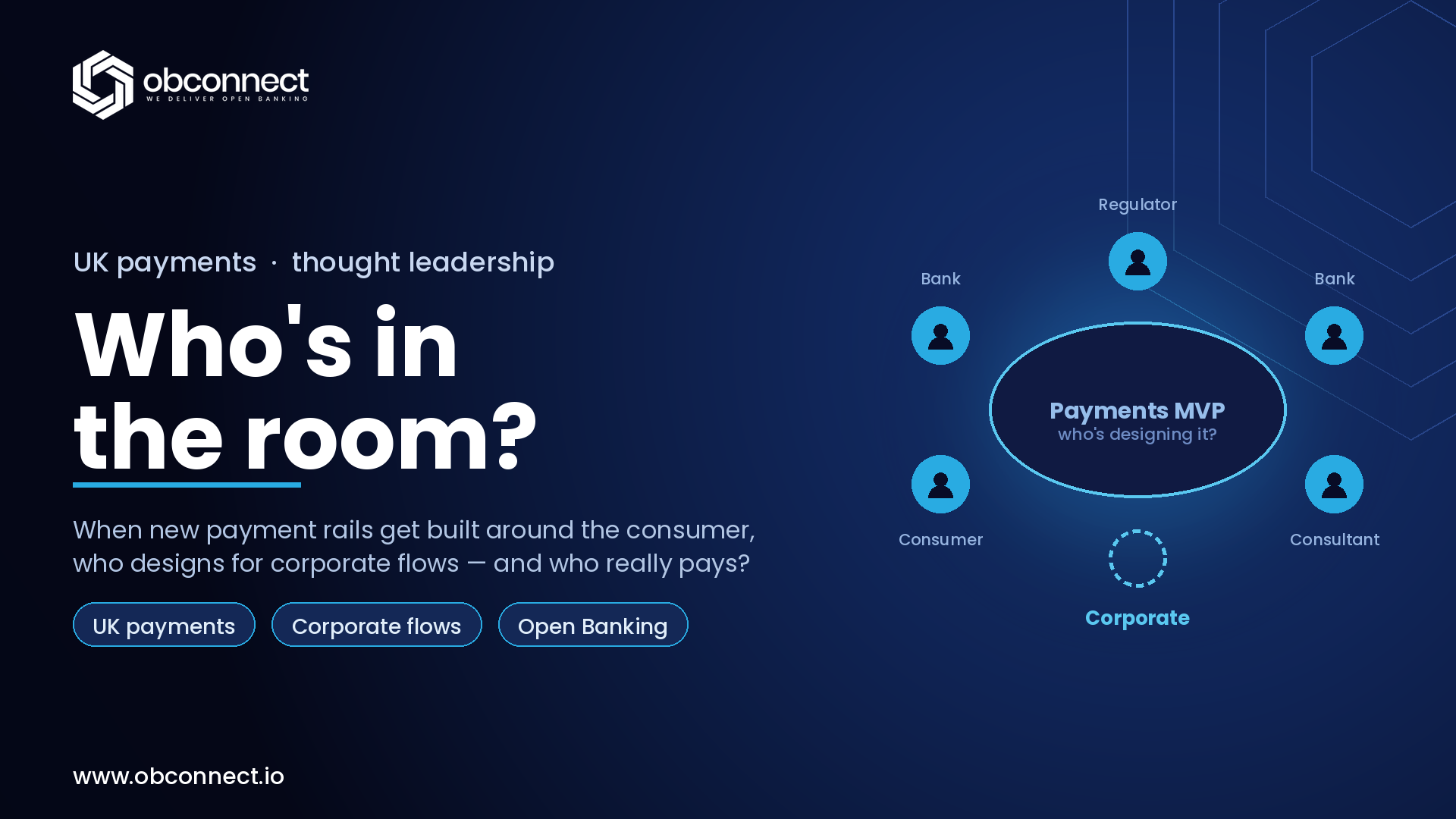
Every new scheme, pilot and minimum viable product starts with a room. Regulators are in it. The big banks are in it. Consultants and vendors – the people, as the roundtable dryly noted, “getting really well paid in it” – are very much in it. The consumer is represented by proxy, through consumer bodies and the political weight of protecting retail customers.
The corporate is usually not there. Not the treasurer trying to reconcile thousands of incoming payments, not the finance director carrying the cost of failed and misdirected transactions, not the business that would actually adopt the rail at scale. So the design optimises for the party in the room. It gets built around the consumer, because that’s whose needs are visible when the decisions are made.
The “free banking” problem nobody wants to price
There’s a second, deeper distortion, and the roundtable named it too: “consumer banking’s free… it’s free.” Free at the point of use is a wonderful thing for retail customers and a genuine British achievement. But nothing is actually free – the cost is simply moved somewhere less visible. It’s cross-subsidised, recovered elsewhere, and very often carried by the corporate side of the ledger.
When you design a payment system around a consumer who pays nothing, you quietly bake in an assumption about who does pay. The economics have to close somewhere, and “somewhere” is usually the business – through merchant fees, through the cost of fraud and reimbursement, through the reconciliation and exception-handling burden that never makes it into the launch deck. Design around free, and you design the corporate into the role of underwriter without ever asking them.
Why banks and financial institutions should care
This isn’t a complaint on behalf of corporates for its own sake. It’s a warning about adoption. Rails built without the corporate use case in mind tend to launch impressively and then stall, because the volume that makes a scheme viable lives in business flows – payouts, collections, high-value and high-frequency payments, the reconciliation-heavy movements where getting the payee right actually matters. If those flows aren’t designed for from day one, they retrofit badly, and the businesses that would have driven adoption stay on the rails they already trust.
For banks and financial institutions, that’s a strategic risk dressed up as a technical footnote. The corporate relationship is where the margin and the loyalty are. A payments landscape designed around the consumer, and paid for by the corporate, is one where those relationships get steadily harder to defend.
What “in the room” actually looks like
Getting the corporate into the room isn’t a governance nicety; it changes the design. It means treating corporate flows as first-class from the MVP stage, not as an enterprise add-on later. It means designing payee verification, reconciliation and exception handling for businesses that process at volume, not just for a single consumer confirming a single payment. And it means being honest about the economics up front – who benefits, who pays, and whether the model still closes when the consumer contributes nothing.
That’s the lens obconnect builds through. Our work on Product Delivery Ecosystems starts from the assumption that banks, corporates and financial institutions all have to be served by the same infrastructure – and that Verification of Payee and Confirmation of Payee have to work for corporate volumes, not just retail confirmations. The corporate isn’t an afterthought to design around later. It’s supposed to be in the room.
The conversation worth having
The roundtable ended before this thread could be pulled properly – “a topic for another conversation,” as someone put it. It deserves to be. Because the question of who’s in the room when UK payments get designed, and who quietly pays for the parts that are “free,” will shape the next decade of the market far more than any single scheme.