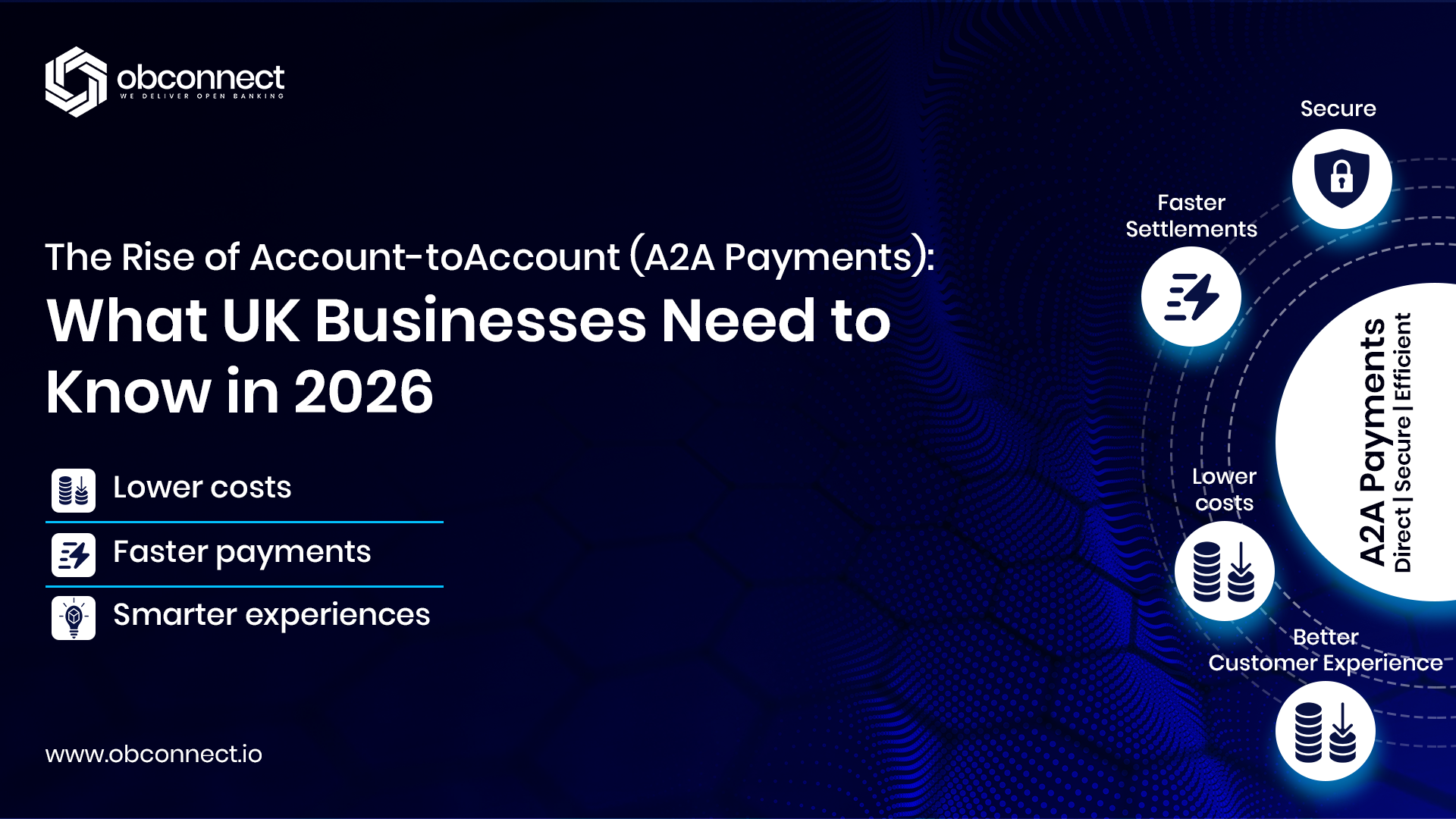
For years, account-to-account (A2A) payments have been discussed as the next evolution in how money moves. Efficient. Direct. Cost-effective.
Yet for a long time, they remained just outside the mainstream – widely understood within the industry, but not fully embedded in everyday business operations. That is beginning to change.
As we move through 2026, A2A payments are no longer a future concept. They are becoming a practical, scalable alternative to traditional payment methods, driven by the continued growth of Open Banking in the UK.
The question for businesses is no longer what are A2A payments?
It is how quickly should we adopt them?
What Are A2A Payments – and Why Do They Matter Now?
At their core, account-to-account payments are exactly what they sound like: payments made directly from one bank account to another, without intermediaries such as card schemes.
In the UK, this is enabled through Open Banking and infrastructure like Faster Payments, allowing funds to move securely and, in many cases, instantly.
On the surface, the concept is simple. But its implications are significant.
By removing layers of intermediaries, A2A payments streamline the transaction process. They reduce dependency on legacy systems. And perhaps most importantly, they give both merchants and consumers greater control over how payments are initiated and completed.
This is not just an incremental improvement. It is a structural shift in how payments are delivered.
The Growth of A2A Payments in the UK
The UK has been one of the leading markets for Open Banking adoption, providing fertile ground for the growth of A2A payments.
What started with early use cases – such as tax payments, utilities, and account top-ups – is now expanding into mainstream commerce.
E-commerce platforms, subscription services, and even large marketplaces are increasingly integrating Pay by Bank options into their checkout experiences.
This shift is being driven by a combination of factors:
- Rising cost pressures on merchants
- Increased consumer familiarity with digital banking
- Regulatory support for Open Banking frameworks
- Continued investment from fintech providers
As exposure increases, so does adoption. Consumers who encounter A2A payments repeatedly begin to view them not as an alternative, but as a normal part of the payment landscape. And that shift in perception is critical.
Why Businesses Are Turning to A2A Payments
For UK businesses, the appeal of A2A payments is both practical and strategic.
At a fundamental level, they offer a more efficient way to move money. But the real value lies in how they improve core aspects of the payment experience.
Cost Efficiency
One of the most immediate benefits is cost.
By bypassing card schemes, A2A payments remove many of the fees associated with traditional transactions – including interchange and scheme fees.
For high-volume businesses, this can translate into significant savings over time.
Greater Control
A2A payments give merchants more visibility and control over transactions.
Payments are authorised directly by the customer through their bank, reducing ambiguity and improving transparency throughout the process.
This aligns with the broader shift towards more controlled and user-driven payment experiences, a key advantage highlighted in Open Banking adoption .
Speed and Cash Flow
Faster settlement times are another major advantage.
With funds often moving in real time, businesses can improve cash flow and reduce reliance on delayed settlement cycles associated with card payments.
For many organisations, this is not just a convenience. It is a competitive advantage.
The Challenges That Still Need to Be Addressed
Despite the clear benefits, A2A payments are not without their challenges.
And it is these challenges that will ultimately determine how quickly adoption accelerates.
Trust and Payment Certainty
As explored in earlier discussions, merchants need confidence that payments will complete successfully.
The absence of a universally recognised confirmation mechanism – similar to card authorisation codes – continues to create hesitation, particularly for high-value transactions .
User Experience
While Open Banking journeys have improved significantly, there is still variability across banks.
Differences in authentication flows, response times, and interfaces can create inconsistency in the checkout experience. For consumers, consistency is key to building trust.
Scalability and Infrastructure
As transaction volumes increase, infrastructure must be able to support always-on, high-performance environments.
Any issues with latency or downtime can directly impact conversion rates and merchant confidence.
As we have seen, infrastructure maturity is a critical enabler of large-scale adoption.
Bridging the Gap: How obconnect Enables A2A Adoption
At obconnect, we see A2A payments not just as a technology shift, but as an opportunity to redefine how businesses approach payments altogether.
Our role is to remove the friction that sits between potential and adoption.
We do this by focusing on the areas that matter most to merchants:
- Reliable, always-on infrastructure that supports high-volume transactions
- Optimised payment flows that deliver consistent user experiences
- Enhanced visibility and validation, helping to build confidence in every transaction
- Seamless integration, allowing businesses to adopt A2A payments without overhauling existing systems
This approach ensures that businesses can unlock the benefits of A2A payments while mitigating the challenges that often slow adoption.
Because ultimately, adoption is not driven by capability alone. It is driven by confidence.
2026 and Beyond: A Defining Period for A2A Payments
The rise of A2A payments is not a sudden disruption. It is a gradual, but decisive, shift.
As more businesses integrate Pay by Bank options and more consumers become familiar with the experience, the momentum will continue to build. What we are seeing in 2026 is the tipping point.
The moment where A2A payments move from “emerging alternative” to a credible, scalable payment method for everyday use.
From Alternative to Standard
Every major shift in payments follows a similar pattern. Initial innovation. Gradual adoption. Eventual normalisation. A2A payments are now firmly in the second phase – moving steadily towards the third.
For UK businesses, the opportunity is clear. Those who act early can benefit from cost savings, improved cash flow, and enhanced customer experiences. Those who wait may find themselves adapting later, under greater pressure.
The technology is ready. The infrastructure is evolving. The only question that remains is how quickly businesses choose to move.
Ready to Explore A2A Payments for Your Business?
At obconnect, we help organisations adopt and scale account-to-account payments with confidence.
If you are looking to reduce costs, improve payment performance, and stay ahead in a rapidly evolving landscape, get in touch with our team today.