Open Banking has made significant progress in the UK.
The technology is robust. The regulatory framework is established. The benefits – from cost reduction to enhanced security – are well understood. Yet despite all of this, one fundamental question continues to hold back widespread merchant adoption:
Can merchants truly trust that they will get paid?
It is a deceptively simple question, but one that sits at the very core of every transaction. Because in payments, certainty is not a “nice to have”. It is the foundation upon which everything else is built.
Why Certainty Matters More Than Speed
There is a common assumption in the payments industry that speed is the ultimate differentiator. Faster settlements, instant transfers, real-time confirmations – these are often positioned as the key advantages of Open Banking.
And while speed is undoubtedly valuable, it is not what merchants prioritise most.
What merchants need above all else is certainty.
When a payment is accepted, a business needs confidence that the funds will arrive without issue. That confidence determines whether goods are released, services are fulfilled, or transactions are completed.
Speed enhances experience. Certainty enables commerce.
Without it, even the fastest payment method becomes difficult to rely on.
The Benchmark: Card Scheme Guarantees
To understand the challenge facing Open Banking, it is important to look at what merchants have become accustomed to.
Card schemes have spent decades building a framework that provides a high level of assurance. When a transaction is authorised, merchants receive a clear signal – an approval code that effectively confirms the payment will be honoured.
This is not just a technical process. It is a trust mechanism.
It allows merchants to proceed with confidence, knowing that even though settlement may happen later, the transaction itself is protected within a well-defined set of rules.
As explored in our analysis of payment evolution, this level of assurance was a critical factor in driving widespread adoption of card payments in the first place .
It removed doubt. And in payments, removing doubt changes everything.
The Current Gap in Open Banking
Open Banking payments follow a similar journey on the surface.
A customer authorises a payment through their bank. The bank processes the request. The funds are transferred via Faster Payments.
However, from a merchant’s perspective, something is missing.
There is no universally recognised, scheme-level confirmation that provides the same level of assurance as a card authorisation code.
Instead, merchants are often required to rely on the funds arriving in their account before treating the transaction as complete. This creates a subtle but important gap.
Even though the payment may be initiated and approved by the bank, the absence of a clear, standardised confirmation mechanism introduces uncertainty. And as highlighted in our Open Banking Challenge Series, this lack of guaranteed payment confirmation remains one of the key reasons why large merchants hesitate to fully embrace Open Banking payments .
It is not that the system does not work. It is that it does not yet feel as certain.
Why This Gap Matters for Merchant Adoption
For smaller merchants or low-risk transactions, this gap may be manageable.
But for high-volume merchants, or those dealing with high-value goods and services, the stakes are significantly higher.
Releasing a product without absolute confidence in payment carries risk. Delaying fulfilment until funds are received introduces friction. Neither outcome is ideal.
At scale, even small uncertainties become operational challenges.
This is why many large merchants continue to default to card payments, despite the potential cost savings and efficiencies offered by Open Banking.
It is not resistance to innovation. It is a rational response to risk.
Closing the Gap: The Case for Scheme-Level Solutions
If Open Banking is to achieve widespread adoption, this trust gap must be addressed.
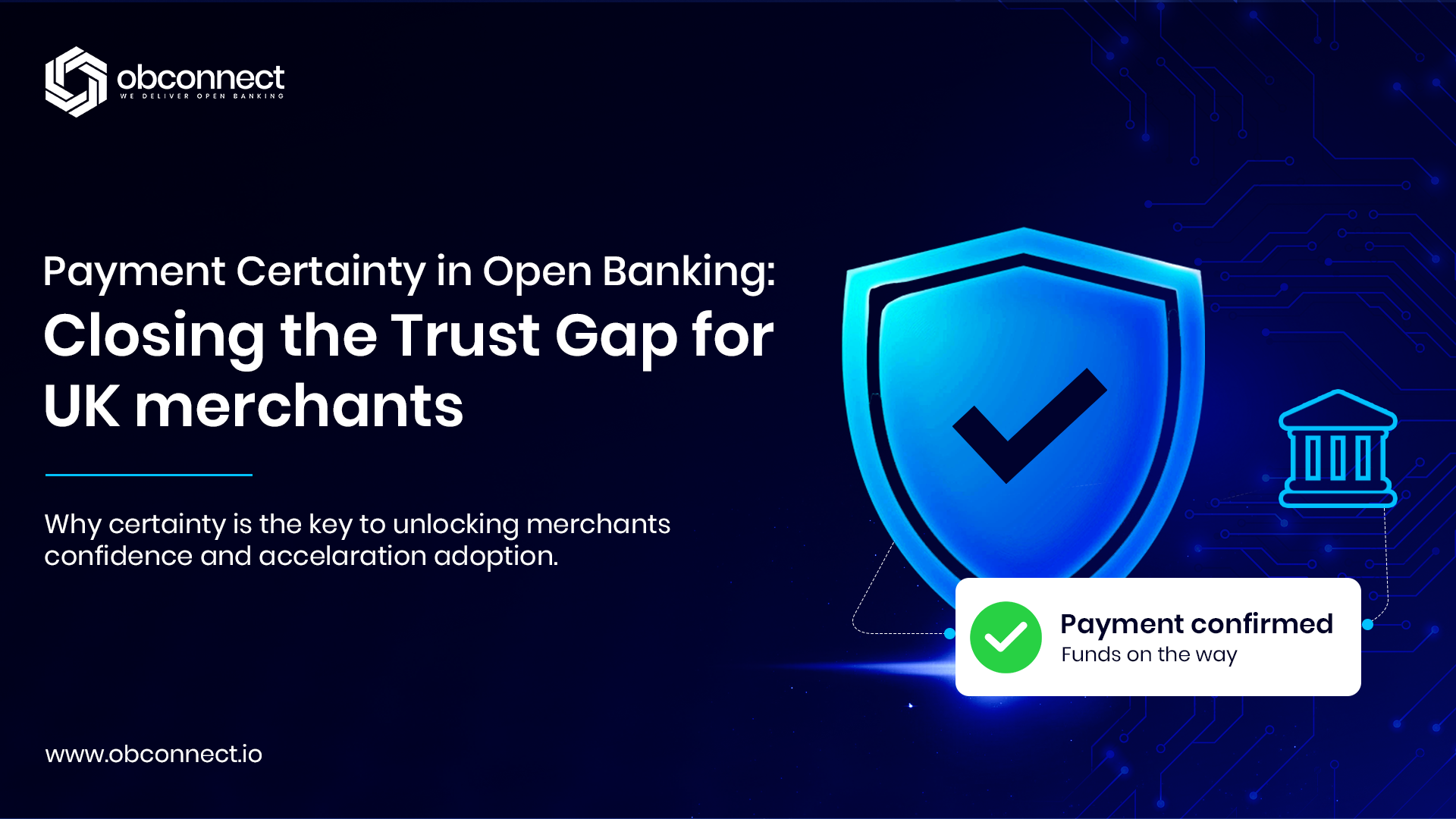
One of the most widely discussed solutions is the introduction of a scheme-level confirmation mechanism – a standardised signal that provides merchants with immediate assurance once a payment has been authorised by the bank.
In practical terms, this could function similarly to an approval code in card schemes. Once the customer authorises the payment and the bank confirms it, the merchant receives a definitive confirmation that the funds are on their way.
This simple addition could have a transformative impact.
It would align Open Banking more closely with the expectations that merchants have developed over decades of card usage. It would reduce uncertainty. And most importantly, it would enable merchants to act with confidence.
Beyond individual transactions, this kind of standardisation would help create a more unified and predictable payment ecosystem – something that is essential for scaling adoption.
The Role of Providers in Bridging the Trust Gap
While scheme-level evolution is critical, the responsibility does not rest solely with regulators or industry bodies.
Providers like obconnect play a key role in bridging the gap today.
By designing payment flows that prioritise visibility, reliability, and communication, it is possible to enhance merchant confidence even within the current framework.
This includes:
- Delivering clear and timely payment status updates
- Optimising connectivity with banking partners
- Reducing latency and improving transaction performance
- Providing enhanced validation and risk mitigation mechanisms
These are not just technical improvements. They are trust-building measures.
Because ultimately, trust in payments is not created by a single feature. It is built through consistent, reliable experiences over time.
A Defining Moment for Open Banking Payments
Open Banking has already demonstrated its potential to reshape the payments landscape.
It offers a more efficient, secure, and cost-effective alternative to traditional methods. It empowers consumers with greater control. It enables merchants to reduce reliance on expensive card infrastructure.
But for it to become truly mainstream, one thing must happen – merchants must trust it.
Closing the payment certainty gap is central to that journey.
It is the difference between a payment method that is technically viable and one that is commercially trusted.
Final Thoughts: Trust Is the True Currency
In the end, payments are not just about moving money. They are about confidence.
Confidence that a transaction will complete. Confidence that funds will arrive. Confidence that the system will work as expected, every time.
Speed can enhance that experience. Cost can improve it. Innovation can reshape it.
But trust is what sustains it. For Open Banking in the UK, the path forward is clear.
Close the certainty gap, and adoption will follow.
Ready to Deliver Payment Certainty in Open Banking?
At obconnect, we help merchants and financial institutions build Open Banking payment experiences that prioritise reliability, performance, and trust.
If you are looking to strengthen payment certainty and accelerate adoption, speak to our team today.